![[ e-networld.de ]](/img/logo.png)
DockerUpdateGuard
Tracks what is actually running in Docker, compares it against registry metadata and shows where updates, vulnerabilities and shared base images need attention.
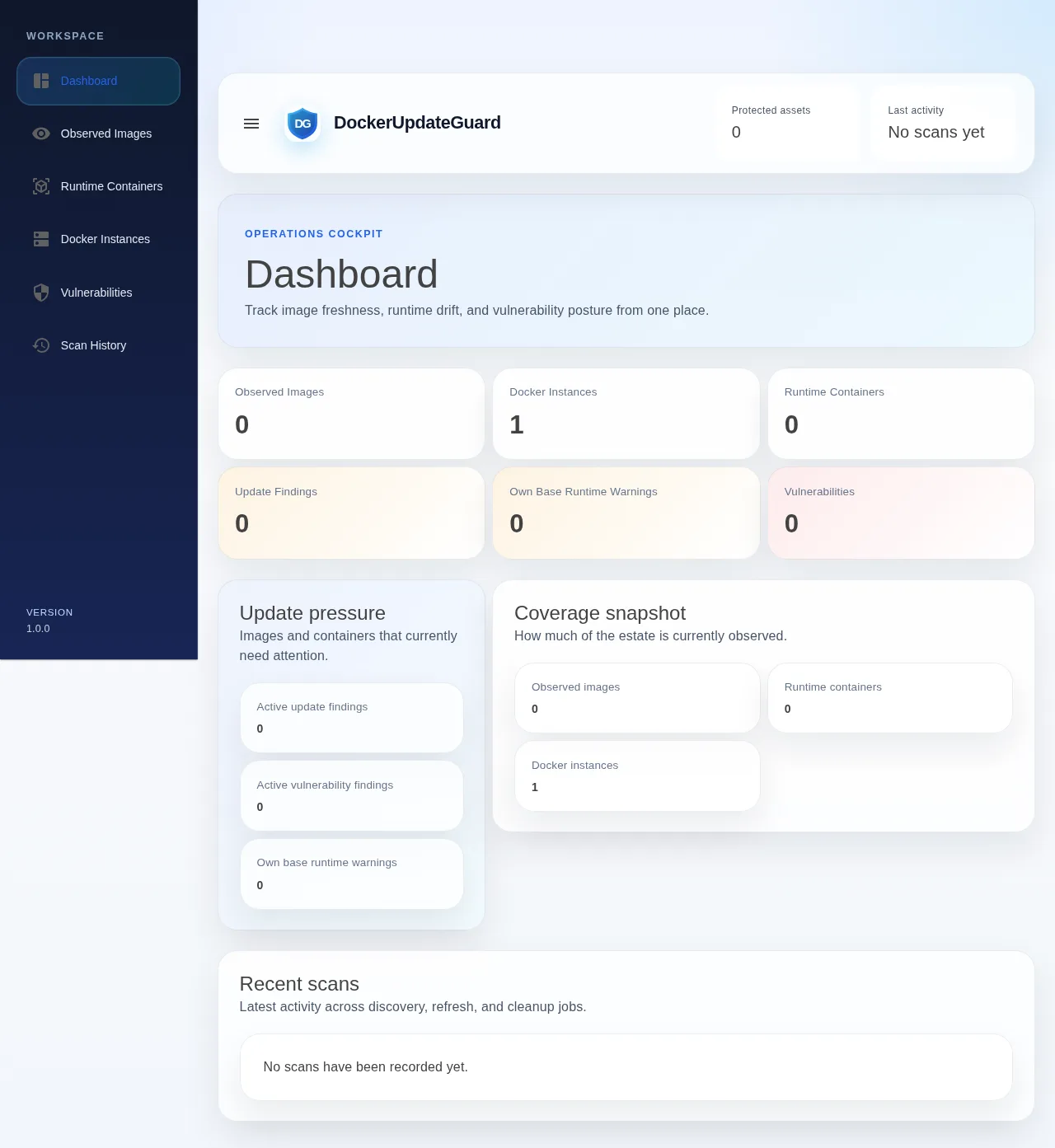
Overview
DockerUpdateGuard keeps an overview of a Docker estate that has grown over time. It maintains an inventory of observed images and of the containers actually running, reconciles both against registry tags and digests, and answers the question that “a newer tag exists” leaves open: which update is worth doing now, and which one can wait?
The application stores its data in PostgreSQL, applying database migrations itself on startup. It talks to one or more Docker Engine endpoints, optionally through the local Unix socket, and can additionally use Docker Hub credentials and Portainer per instance. The interface is split into dashboard, observed images, runtime containers, Docker instances, shared base images and scan history.
Two behaviours set it apart from a simple update notifier. First, it resolves alias tags: if latest points at the same digest as a version tag, the concrete version is named. Second, it treats major upgrades conservatively. A new major line is only recommended once it has reached a minimum number of releases and a minimum age, and while the previous line is still maintained alongside it, the upgrade stays deferred.
Vulnerability data can come from Trivy in client mode or from Docker Scout. The published container image already ships the Trivy command line. Docker Hub requests work against a per-window request budget, so scheduled scans never exhaust the rate limits and manual scans remain possible.
Features
Installation
docker run -d \
--name dockerupdateguard \
-p 8080:8080 \
--mount type=bind,source=/var/run/docker.sock,target=/var/run/docker.sock \
-v /path/to/appsettings.json:/app/appsettings.json:ro \
networlddev/dockerupdateguard:latestA PostgreSQL database is required; migrations run automatically on startup. When the Docker socket is mounted, the instance BaseUrl has to point at unix:///var/run/docker.sock.
Releases
v1.3.7 · 17/09/2026
- Expand .editorconfig rules, update Reihitsu.Analyzer version
- Bump the actions group with 2 updates
- Bump the nuget-dependencies group with 6 updates
- Bump the actions group with 2 updates
- Bump the nuget-dependencies group with 3 updates
- Bump softprops/action-gh-release from 3.0.2 to 3.0.3 in the actions group
- Bump the nuget-dependencies group with 2 updates
- Bump the nuget-dependencies group with 10 updates
- Bump the actions group with 2 updates
v1.3.6 · 15/08/2026
- Bump the actions group with 2 updates
- Bump the nuget-dependencies group with 2 updates
- Bump the nuget-dependencies group with 3 updates
- Bump the actions group with 2 updates
- Bump the nuget-dependencies group with 9 updates
- [Repo] Fix build config duplicate, CI format gate, outdated docs
- Scope vulnerability data to live images and add manual rescan
v1.3.5 · 29/07/2026
- Defer major upgrades while the current version line is still maintained
- Guide vulnerability setup and show the next scheduled refresh
- Harden the vulnerability refresh pipeline against long-running scans
v1.3.4 · 27/07/2026
- Implement major version upgrade policy for semantic versioning
- Anchor vulnerability scan deltas to scan runs instead of a time window
- Reactivate resolved vulnerability findings instead of duplicating rows
- Keep image versions enriched by a run out of its stale finding pass
- Extract the vulnerability assessment card into a shared component
- Update NuGet packages and remove redundant null-forgiving
- Lead the vulnerability card with an actionability statement
- Capture Trivy fix status and package class on vulnerability findings
- Collapse severity and delta chips behind an expandable detail area
v1.3.3 · 26/07/2026
- Constrain usage-history charts to their card bounds
- Fix vertical text in runtime container update-state cards on mobile
- Bump the nuget-dependencies group with 1 update
- Bump the actions group with 2 updates